
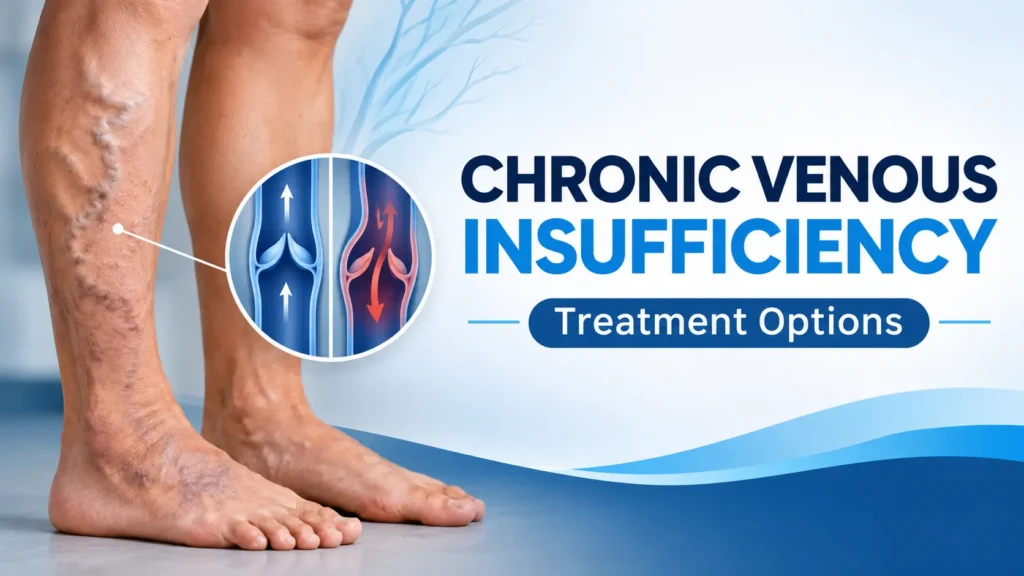
Do your legs feel heavy and tired by the end of the day? Do you see swollen ankles, bulging veins, or skin that looks darker than before? These can be signs of chronic venous insufficiency, a common problem where the veins in your legs struggle to send blood back up to the heart. Many people live with it for years because they think it is just part of getting older. It is not and it can be treated. In this post, we explain what chronic venous disease is and go through the best treatment options, from simple daily habits to modern, minimally invasive procedures.
What is Chronic Venous Insufficiency?
Your leg veins carry blood back to the heart and they have to work against gravity. Small valves inside the veins open to let blood move up and close to stop it from falling back. In chronic venous insufficiency, those valves become weak or damaged. Blood leaks backward and collects in the lower legs and the pressure inside the veins slowly builds.
You may also hear the term chronic venous disease. It is a wider label that covers everything from spider veins and varicose veins to long-term swelling, skin changes and open sores near the ankle. Chronic venous insufficiency usually describes the later, more troublesome end of that range.
Common signs include heavy or aching legs, swelling around the ankles, night cramps, itching and brown patches on the skin. Some people get wounds that heal very slowly. Family history, pregnancy, long hours on your feet, extra weight and past blood clots all raise the risk.
Why You Should Not Wait
The valves do not repair themselves, so chronic venous insufficiency rarely goes away on its own. Symptoms usually creep up over the years. Left alone, the skin can thin, harden, or break down into an ulcer that takes months to heal. Treating chronic venous disease early is simpler and you get relief sooner.
Lifestyle Changes
Most doctors start here. Walk every day, because your calf muscles act like a pump for your veins. Raise your legs above heart level for 15 to 20 minutes a few times a day. Try not to sit or stand in one spot for hours. If you carry extra weight, losing some of it takes pressure off your legs.
These steps ease symptoms, but they do not fix a damaged valve. Think of them as support, not a cure.
Compression Stockings
Compression stockings squeeze the leg gently, with the most pressure at the ankle. This helps push blood upward and cuts down swelling. Size and strength matter, so get fitted instead of buying a random pair. Many people find them hot and tight and stop wearing them. If that happens to you, tell your doctor, because there are other ways to treat the problem.
Minimally Invasive Treatments
For most people with chronic venous insufficiency, this is where lasting relief comes from. These treatments work from inside the vein through a tiny puncture, so there are no large cuts. They are often done under local anaesthesia and most people go home the same day.
Endovenous ablation uses laser or radio waves to heat and close the faulty vein. Blood then flows through healthy veins nearby.
Sclerotherapy uses an injection to close smaller veins and spider veins. A foam version is sometimes used for larger ones.
Medical glue closure seals the vein with a special adhesive. Since no heat is used, you may need less numbing.
Vein stenting solves a different problem: a blockage in a deeper vein, often in the pelvis or upper leg. A small mesh tube holds the vein open so blood can flow again.
Open surgery, such as vein stripping, used to be the standard. Today it is kept for certain large or twisted veins that cannot be treated another way.
How the Right Treatment is Chosen
There is no single best option for everyone. The choice depends on which veins are leaking, how bad the damage is, your general health and your daily routine. The first step is usually a duplex ultrasound, a painless scan that shows blood flow and valve problems as they happen. With that map, your specialist can pick what fits and sometimes combine two, such as ablation for a main vein and sclerotherapy for smaller ones.
When to See a Specialist
Book a visit if swelling does not go down overnight, if your skin is changing colour or feels tight, if you have a sore near the ankle that is not healing, or if leg pain is getting in the way of work or sleep. Chronic venous disease is easier to manage when it is caught early. An experienced endovascular surgeon can scan your legs, explain what is going on and go through your options in plain language.
If your legs have felt heavy for months, do not put it down to age or a long day. Chronic venous insufficiency is common and today there are good ways to treat it.