
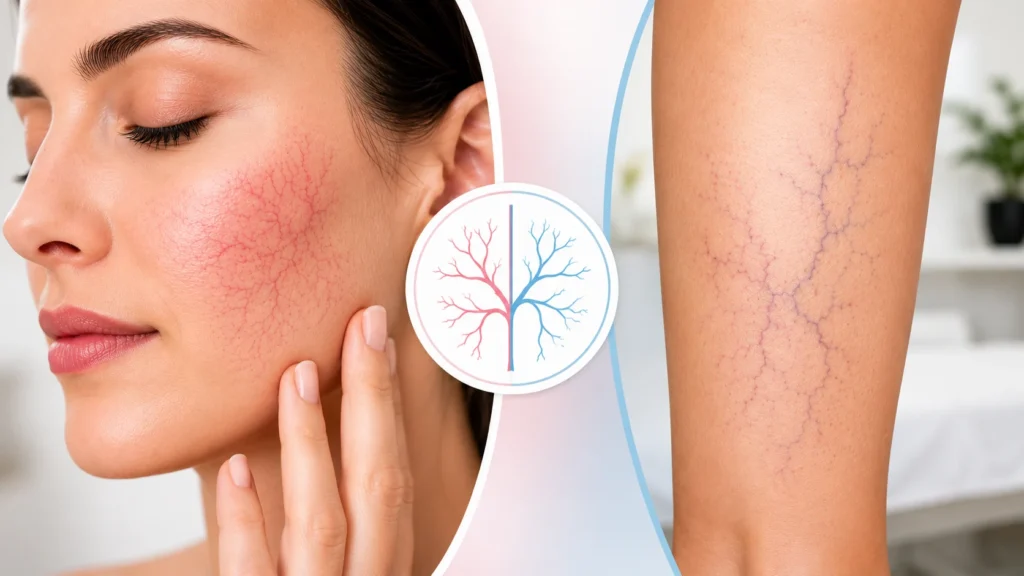
Spider veins show up in different places for different reasons — and where they appear actually changes how we think about treating them.
A patient with fine red veins across the cheeks is dealing with a different set of contributing factors to a patient with web-like blue and purple veins on the back of the calf. Both are spider veins. Both can be treated. But the right approach is not always identical for both.
We see both types regularly in our practice in Dubai and Abu Dhabi, and one of the most common questions patients ask is simply: does the same treatment work for both?
Here is a clear answer, based on how spider veins actually behave and how we approach spider veins treatment in Dubai.
What Are Spider Veins?
Spider veins, medically known as telangiectasia, are small, dilated blood vessels that appear close to the surface of the skin. They get their name from their appearance — a web-like or branch-like pattern that spreads out from a central point, similar to the legs of a spider.
Spider veins are different from varicose veins. Varicose veins are larger, raised, and often cause physical discomfort due to underlying valve dysfunction in the deeper venous system. Spider veins are smaller, flatter, and primarily a surface-level vascular issue — though they can still cause symptoms such as itching, burning, or aching in some cases.
Why Spider Veins Develop in the First Place
The underlying causes of spider veins are largely the same whether they appear on the face or the legs. Genetics plays a significant role — if your parents had visible spider veins, your likelihood of developing them increases. Hormonal changes, prolonged periods of standing or sitting, obesity, and sun exposure are all recognised contributing factors.
What differs is which of these factors tends to dominate depending on the location.
Facial Spider Veins Dubai Patients Notice Most: What Drives Them
Facial spider veins in Dubai patients are very commonly linked to sun exposure. This region experiences intense, sustained UV exposure for most of the year, and the skin on the face is thinner and more delicate than the skin on the legs. Repeated sun exposure over years weakens the small blood vessels close to the surface, causing them to dilate and become visible.
Facial spider veins typically appear on the cheeks, around the nose, and sometimes on the chin. They tend to be fine, red, and thread-like in appearance, often spreading in a delicate network rather than the thicker, more clustered pattern seen on the legs.
Hormonal changes can also contribute to facial spider veins, and some patients notice them becoming more prominent during pregnancy or with certain hormonal conditions.
Leg Spider Veins: What Drives Them
Spider veins on the legs are more closely linked to prolonged standing or sitting, genetics, hormonal changes, and obesity. The veins in the legs work against gravity to return blood to the heart, and this constant pressure — especially in people who spend long hours on their feet or sitting still — contributes to the small surface veins becoming visible over time.
Leg spider veins tend to appear in clusters, often on the thighs, calves, or around the ankles. They are usually a deeper red, blue, or purple compared to the finer red veins typically seen on the face, and they are more frequently associated with mild aching or heaviness, particularly after long periods of standing.
Does the Same Treatment Work for Both?
The treatments available for spider veins are broadly the same for both face and legs — but the way they are applied, and which option is most suitable, depends on the location.
Sclerotherapy
Sclerotherapy involves injecting a solution directly into the affected vein, which causes it to close off and gradually fade. It is considered one of the most effective treatments for spider veins and is widely used for veins on the legs, where the vessels are generally larger and more accessible for injection.
Sclerotherapy can be used on facial veins in some cases, but because facial veins are finer and the skin is more delicate, the approach requires more precision and is typically reserved for veins that are large enough to be treated this way safely.
Laser Therapy
Laser therapy uses laser energy to target and collapse the affected veins. This is often the preferred option for facial spider veins, because the fine, thread-like veins typical of the face respond well to the precision of laser treatment without the need for injections in sensitive facial skin.
Laser therapy is also a commonly used option for leg veins, particularly for finer surface veins that are not well suited to sclerotherapy.
Radiofrequency Ablation
Radiofrequency ablation is a more advanced technique used for treating veins, generally applied to larger or more complex vein patterns. This option tends to be more relevant for leg veins, given the typical size and depth of veins in that area compared to the finer veins seen on the face.
How We Decide on the Right Approach
Choosing between sclerotherapy, laser therapy, or radiofrequency ablation is not a one-size-fits-all decision. It depends on the size, location, and severity of the veins, along with the patient’s individual preferences and medical history.
The process always starts with a proper diagnostic assessment. This includes a thorough physical examination and a review of medical history. In some cases, a Doppler ultrasound is used to evaluate the extent and severity of the veins, particularly when there is uncertainty about whether deeper venous issues are contributing to the visible surface veins.
Once we have a clear picture of what is causing the spider veins and how extensive they are, we can recommend the treatment option best suited to the specific case — whether that is on the face, the legs, or both.
What to Expect Before and After Treatment
Preparing properly for spider vein treatment helps ensure the best possible outcome. This may include certain lifestyle modifications or adjustments to medication in the lead-up to treatment, depending on the individual case.
After treatment, proper post-treatment care supports healing and helps minimise the risk of complications. Spider vein treatment is generally considered safe when performed by a qualified healthcare professional, though as with any medical procedure, there are potential risks, including minor bruising, temporary skin discoloration, or in rare cases, allergic reactions. These are discussed with every patient before treatment begins.
Preventing Spider Veins From Returning
Treatment addresses the veins that are already visible, but prevention plays an important role in reducing the likelihood of new spider veins developing.
For facial spider veins, consistent sun protection is one of the most effective preventive measures, given how strongly UV exposure contributes to their development in this climate.
For leg spider veins, regular exercise, maintaining a healthy weight, wearing compression stockings where appropriate, and avoiding prolonged periods of sitting or standing all support better vein health over time.
FAQs
Can the same spider veins treatment be used on both the face and legs?
The same general treatment categories — sclerotherapy, laser therapy, and radiofrequency ablation — are available for both areas, but the most suitable option depends on the size, depth, and location of the veins. Facial veins are often treated with laser therapy due to the fine, delicate nature of facial skin, while leg veins are frequently treated with sclerotherapy.
Is spider vein removal Dubai treatment safe for facial veins?
Yes, when performed by a qualified healthcare professional. As with any treatment, there are potential minor risks such as bruising or temporary skin discoloration, which are discussed during consultation.
Why are facial spider veins more common in Dubai?
Sun exposure is a major contributing factor to facial spider veins, and Dubai’s climate involves intense, sustained UV exposure for much of the year. This makes facial spider veins a common concern among patients in the region.
How many sessions are typically needed to treat spider veins?
This varies depending on the extent and severity of the veins, as well as the treatment method used. A proper assessment is needed to give an accurate expectation for any individual case.
Will spider veins come back after treatment?
Treated veins that close off do not typically reappear, but new spider veins can develop over time if the underlying risk factors are not managed. Prevention measures such as sun protection and avoiding prolonged standing or sitting help reduce the likelihood of recurrence.
Book a Consultation
Spider veins on the face and on the legs are not the same problem, even though they share a name and a general cause. Getting the right treatment means understanding which factors are driving the veins in your specific case and matching that to the most appropriate option.
At our clinic, we assess each patient individually before recommending sclerotherapy, laser therapy, or another suitable approach for spider vein removal Dubai patients can rely on, across both Dubai and Abu Dhabi.
We are located at 105 Saif Ghobash Street, Al Rawdah, Abu Dhabi, United Arab Emirates. Call us on +971 02 494 4550 or visit drabdulrahman.com/spider-veins to book your appointment.


Pingback: Sclerotherapy Dubai vs Laser for Spider Veins: Which Is Better for You? - Dr Abdul Rahman